
Art as an Expression of National Identity
In every line drawn by the artist, in every shade chosen, in every creative gesture, there lies a larger story — the story of a nation.
Art is not merely an aesthetic language; it is a living form of memory, a sensitive archive of the collective soul. Through art, a people tells its history, recalls its roots, and affirms its uniqueness before the world.
Roots and Symbols
National identity is a complex fabric woven from traditions, beliefs, myths, and shared experiences. In art, these layers become visible.
An embroidered pattern, a stained glass window capturing the light of a medieval cathedral, a ritual dance, an ancestral melody — all are ways through which the essence of a nation becomes visible and eternal.
In Romania, for instance, traditional art carries symbolic codes thousands of years old: the spiral of life, the cosmic tree, the solar cross, or the legendary bird Măiastră. These symbols are not mere decorations, but languages of identity — bridges between the material and the spiritual worlds.
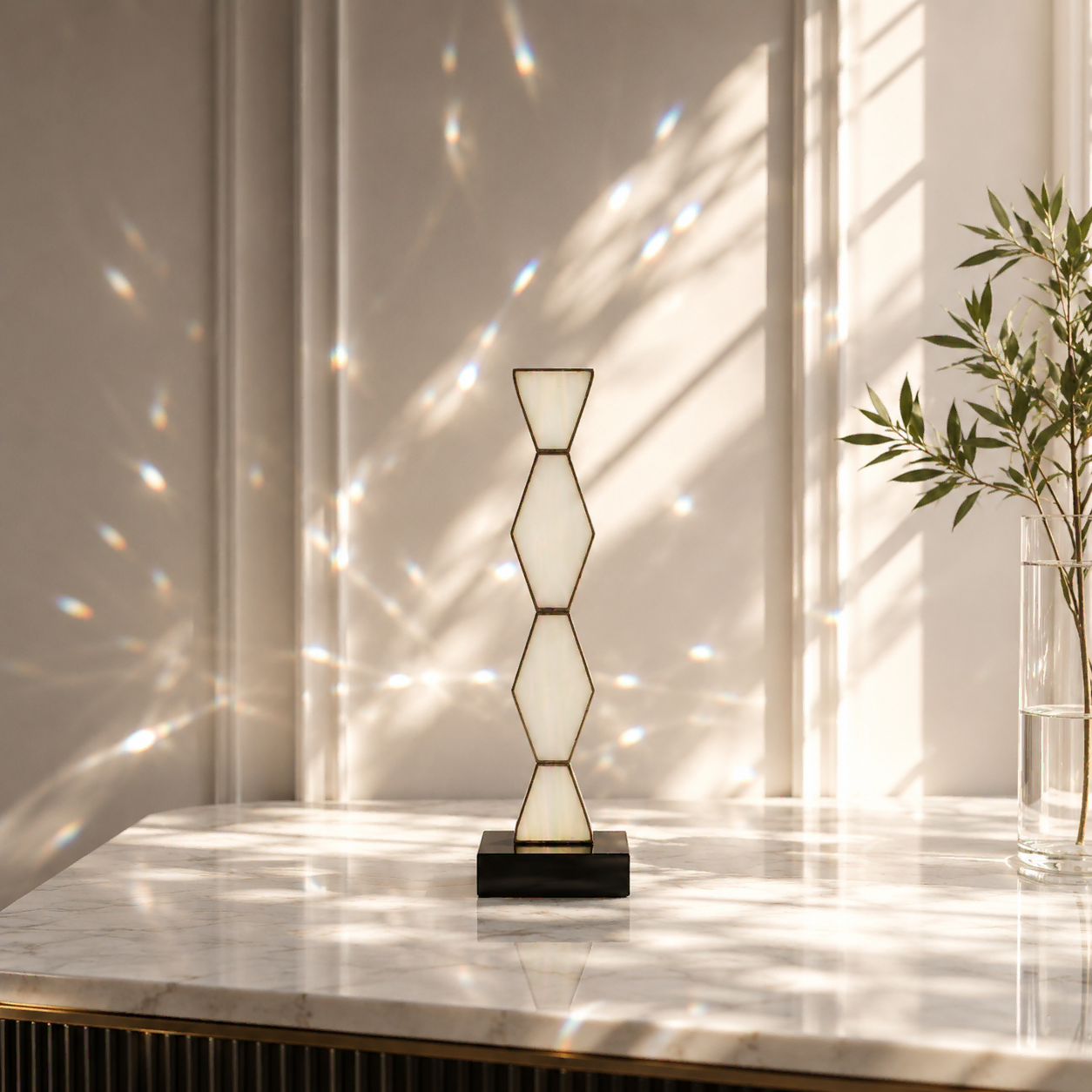
Light Column
Identity and Universality
While art reflects the particular essence of a nation, it also transcends borders.
Precisely through the sincerity and depth with which it expresses what is local, art becomes universal.
When a stained glass piece inspired by Romanian symbolism reaches an international gallery, it no longer speaks only of Romania — it speaks of the shared human beauty of belonging, of the universal longing for light and meaning.
Contemporary Art – Between Tradition and Globalization
Today, artists navigate between two worlds: that of roots and that of global connections. The challenge is not to lose authenticity in the face of cultural uniformity.
Contemporary art carries the mission of integrating the past into the present — transforming national motifs, myths, and energies into new, relevant expressions for a world in constant transformation.
For contemporary stained glass artists, cultural heritage can become a rich source of artistic inspiration. Traditional symbols, folk motifs, mythology, architecture, and stories can be reinterpreted through glass, light, color, and form, transforming elements of cultural identity into original contemporary artworks.
In my own artistic practice, I explore this connection between cultural heritage and stained glass, allowing symbolic subjects and cultural references to become part of a contemporary visual language.
The work of Constantin Brâncuși offers a powerful example of how cultural heritage can become a source of contemporary artistic language. As one of Romania’s most influential artists, Brâncuși transformed essential forms and ideas rooted in his cultural heritage into a universal sculptural vocabulary. His exploration of simplicity, movement, balance, and the essence of form continues to inspire contemporary artists.
Inspired by this sculptural language, I created a series of stained glass artworks that reinterpret the idea of essential form through glass, light and transparency, and color.
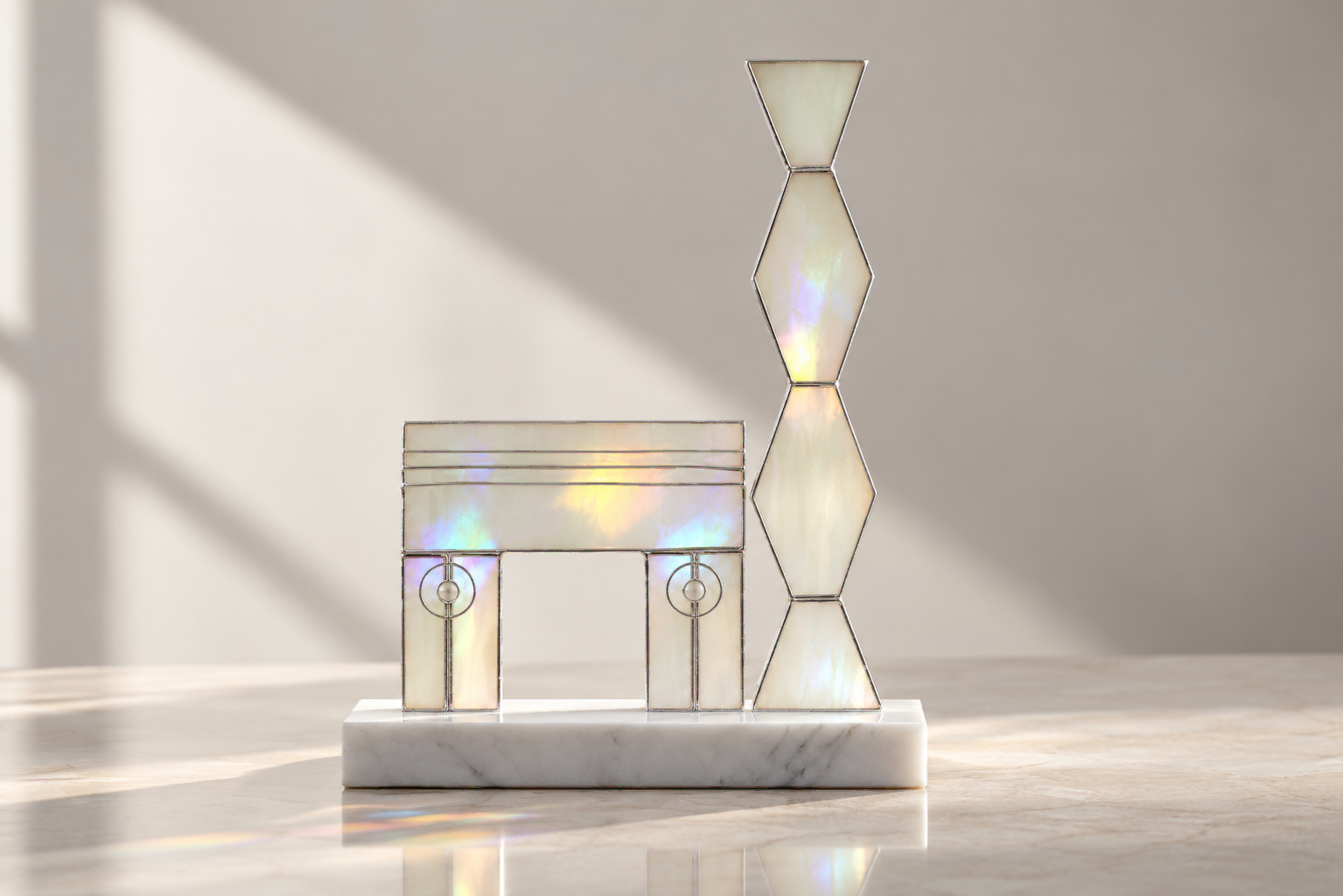
Embrace
Cultural Themes in Stained Glass Art
Stained glass is particularly suited to expressing cultural themes because light becomes part of the artwork itself. A traditional symbol or motif can be transformed through transparency, color, reflection, and composition, allowing heritage to be experienced in a new visual form.
This approach creates a bridge between cultural memory and contemporary art: the meaning of a symbol remains rooted in its origins, while the artwork speaks to a contemporary audience through the language of glass and light.
Identity as Inner Light
True national identity in art does not impose itself through pride, but reveals itself through vibration.
It lives in the harmony between tradition and innovation, in the light an artist brings into the world through creation.
Each artwork thus becomes a window into the soul of a nation — a reminder that, no matter how far we travel, we always carry within us the light of the place we come from.
In every ancient symbol lies a vibration beyond words — a path toward remembrance. Through art, we awaken that language again: the one spoken by the heart, in light.