
the Making of Primordial Egg
The mirror of creation — where duality becomes ONE
Some works begin with a material. Others begin with an idea.
Primordial Egg began with a question: what might the moment of creation look like if it could be held in a mirror?
The work began with the transformation of an hand-carved wooden frame. Restored and reimagined through 24K gold leaf, a smoked oval mirror, and hand-cut stained glass, it became a meeting point between memory and renewal, matter and light. Each element was chosen not only for its beauty, but for what it could evoke — the origins, the longing for connection, and the profound human desire to become whole.
From an antique frame to a new beginning
At the heart of the work was a vintage hand-carved wooden frame — an piese of art that had already lived another life and carried the quiet traces of time.
Rather than replacing its history, I chose to transform it.
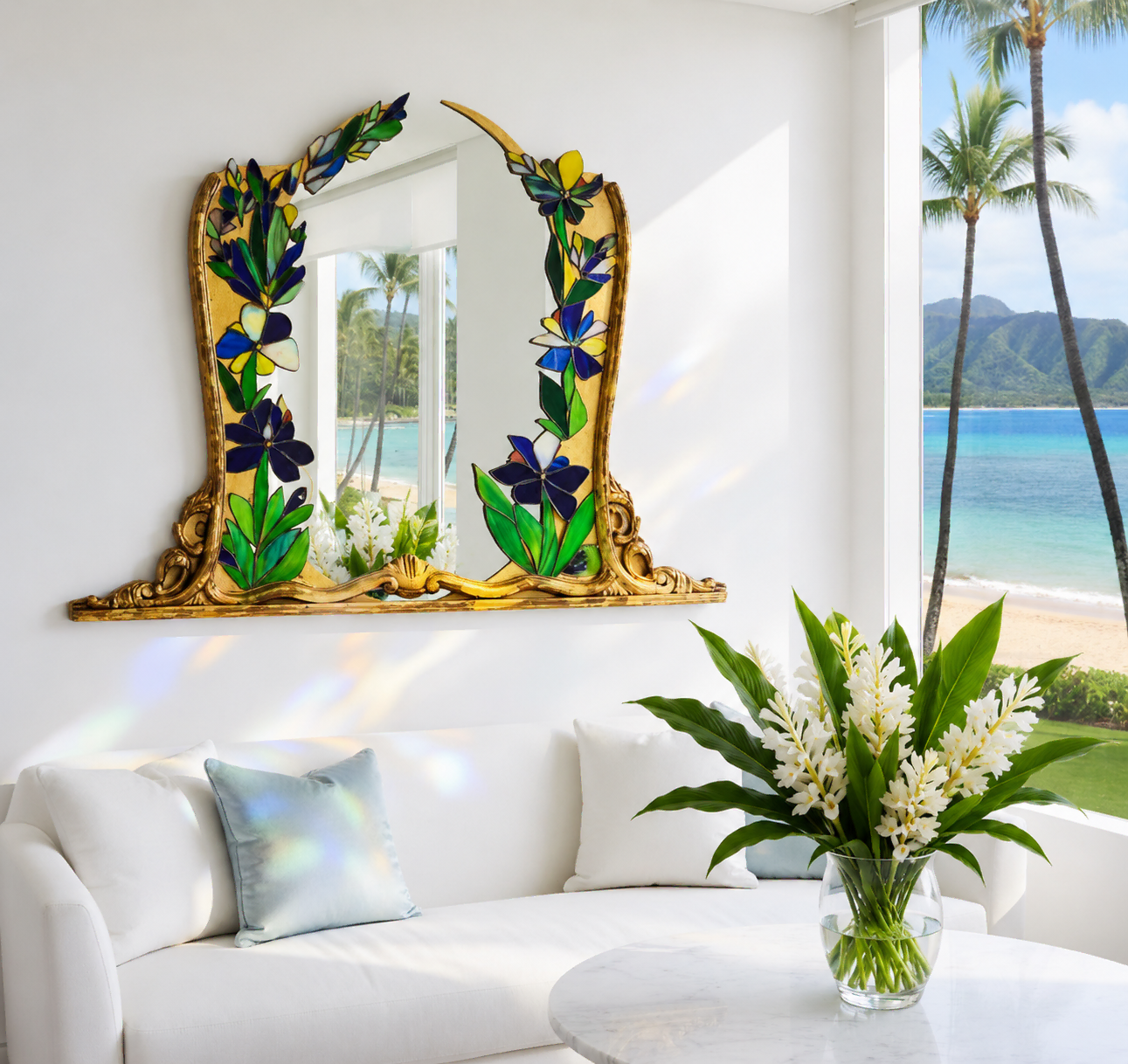
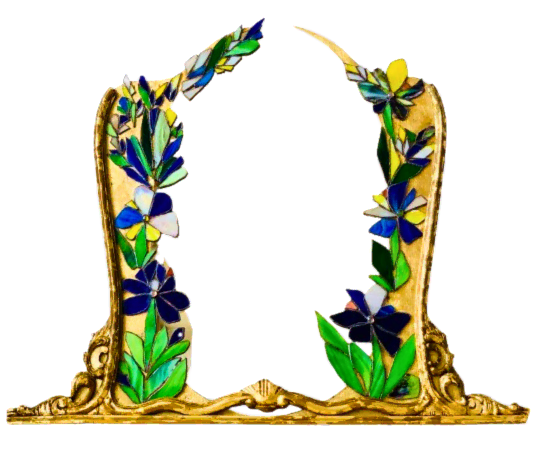
The frame was carefully restored and covered in 24K gold leaf, allowing its carved structure to catch and release the light. The gold became more than an ornamental finish: it introduced the idea of illumination, turning an antique object into something that seemed to belong to another realm.
Its subtle reflections change as the viewer moves around the piece, creating a sense that the work itself is quietly breathing with light.
The mirror as the cosmic egg
The central oval mirror became the soul of the composition.
Its shape recalls the primordial egg — one of humanity’s oldest symbols of creation, gestation, potential, and the beginning of existence. Across ancient cosmologies, the cosmic egg represents the moment before separation: when everything exists within one unified whole.
For this reason, I chose a smoked mirror rather than a perfectly clear reflection.
Its surface does not offer an immediate, flawless image. Instead, it softens the reflection and creates a sense of distance, inviting the viewer to look inward.
The mirror becomes less about appearance and more about recognition
A threshold between the visible and invisible, between who we are and who we are becoming.
Iris flowers: from matter toward spirit
Around the golden structure, the iris petals were individually designed, hand-cut, and assembled in stained glass.
Their colors move through violet, deep blue, and sunlit yellow — a palette chosen to evoke intuition, wisdom, transformation, and the first light of dawn.
The flowers do not simply frame the mirror. They rise around it.
Their ascending movement was essential to the composition. The eye naturally follows the stems upward, creating a visual journey from the material world toward something more ethereal.
Each petal had to be considered in relation to the next: its shape, its color, the direction of the light, and the way the glass would respond once illuminated.
This is where the language of stained glass becomes particularly. The color does not merely sit on the surface. It comes alive through light.
The Golden Spiral
At the upper part of the composition, the two floral stems ascend toward one another.
This creates the Golden Spiral — a subtle structural element representing the movement of two primordial forces toward equilibrium.
Two sides. Two energies. Two halves.
And, ultimately, one.
The spiral became a visual expression of the central idea behind Primordial Egg: that creation is not necessarily born from separation, but from the meeting of complementary forces.
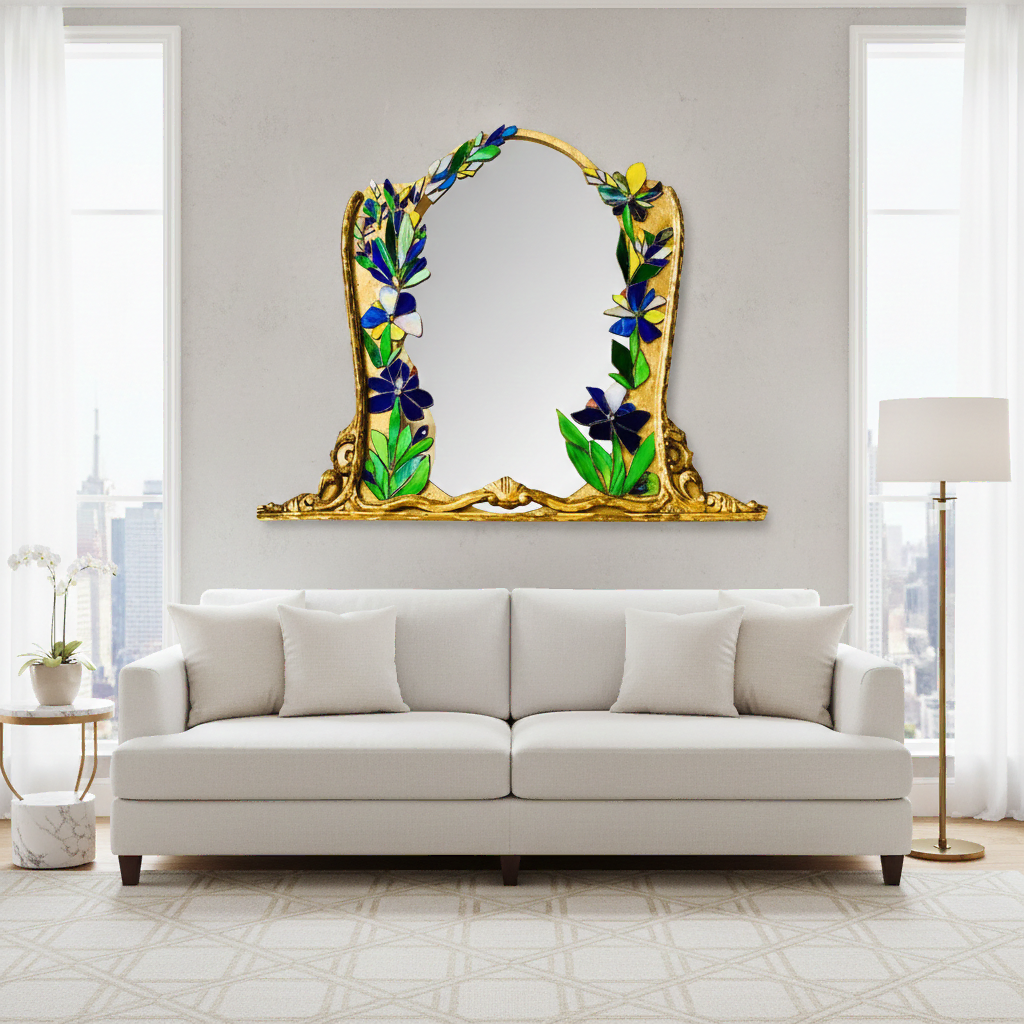
The composition therefore moves continuously between dualities
Masculine and Feminine, Darkness and Light, Matter and Spirit, Individuality and Union.
When glass becomes mythology
Working with stained glass means accepting a certain degree of unpredictability.
The glass has its own character. Its surface, transparency, texture, and reaction to light can never be completely controlled. Every cut changes the relationship between the pieces surrounding it, and every soldered line becomes part of the final drawing.
For Primordial Egg, this physical process became inseparable from the symbolic one.
The work speaks about transformation because it was itself created through transformation: wood became gold, glass became flowers, a mirror became a portal, and separate fragments became a single composition.
The materials remained what they were — yet together, they became something entirely different.
The moment of becoming
The final work is intended to hold the stillness of the moment just before creation fully reveals itself.
The smoked mirror recalls the silence of a lake. The gold suggests the first emergence of light. The ascending irises evoke awakening. And the meeting of the two stems brings the composition back to its central idea: duality becoming one.
Perhaps this is why the mirror feels less like an object to look at and more like an invitation to look within.
Primordial Egg is ultimately a work about beginnings — not only the beginning of the universe, but the beginnings that happen within us: moments of rebirth, transformation, recognition, and the awakening of something that was already there.
A reminder that creation is always both an ending and a beginning.
And that sometimes, in the space between two halves, wholeness is waiting to emerge.